Spatial navigation, learning, and decision making in C. elegans

We are exploring C. elegans’ learning and decision making in the structured environment of T-shaped mazes. Using 3D printing technology, we create the WormMaze Platform and we test nematodes’ biased/unbiased decision making and learning, triggered by the presence of food bait at one maze end. We find that C. elegans are capable of learning in a maze, even in the context of conflicting stimuli. We are working on untangling the multisensory mechanism that steers this behavior, and on deciphering the effect of aging. Related publications: here, and here.
A mathematical framework for C. elegans‘ neuronal circuitry that steers chemotaxis, learning, and navigation
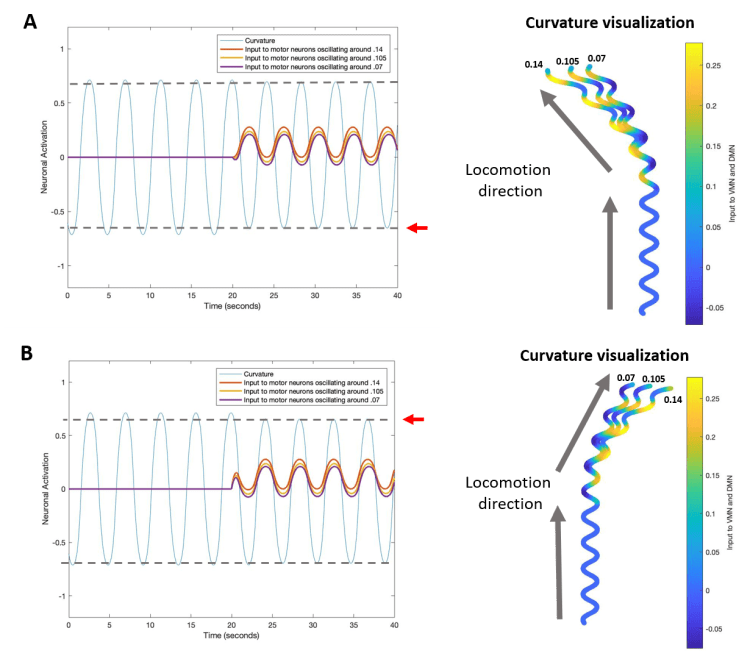
We are working on a mathematical framework for C. elegans chemosensory and locomotive circuitry that captures nematode behavior and predicts underlying mechanisms that generate learning, chemotaxis, and navigation. Based on known neural circuitry, the model worm responds to food-released chemical cues by modulating motor neuron activity that drives simulated locomotion. We use our model to fine tune experiments, generate testable hypotheses, and predict neuronal circuit function. We are currently working on developing a neuromechanical model that integrates proprioceptive feedback. Collaboration with Victoria Booth, Department of Mathematics, University of Michigan. Related publications: here.

We explore C. elegans locomotion in complex, changing environments. We create quasi2D, soil-like, granular arenas for nematodes and we use convolutional neural networks (CNN) and a deep learning particle tracking package to track their locomotion and changes in particle packing. We investigate the mechanisms that shape the decision making process as animals move through particles of varying density and properties, and enable locomotive and, more broadly, behavioral adaptability. Collaboration with Hongyi Xiao, Mechanical Engineering, University of Michigan.
3D-printing technology for C. elegans 3D behavioral arenas
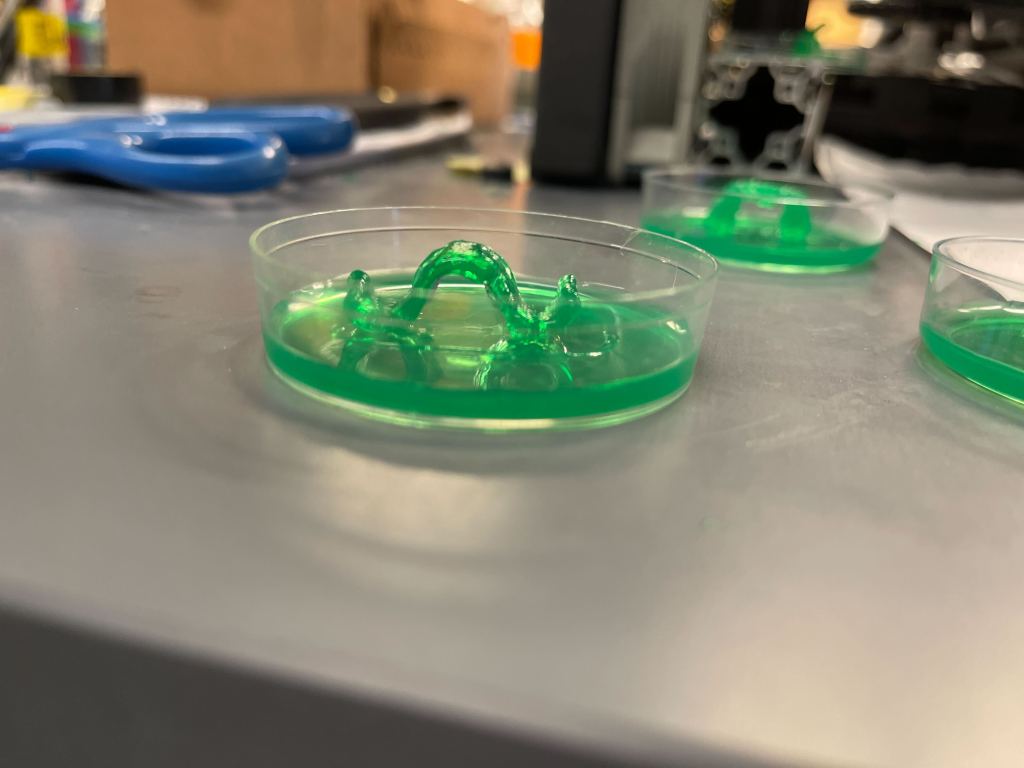
We are using custom-made behavioral platforms to study how aging and genetic background affects spatial learning and decision making in C. elegans. Thus far we have been creating simple T-shaped mazes that allow us to obtain exciting results. Multilayered, 3-dimensional arenas, however, would be a significantly more insightful means to study navigation and spatial learning. They would also constitute a terrain more similar to nematodes’ natural environment. Our prototype hydrogel-ink 3D printer enables agar bioprinting for the creation of 3-dimensional behavioral arenas for nematodes. Related publications: here.
Control theory and robotics for C. elegans locomotion and learning

Much of C. elegans‘ learning is expressed through changes in its locomotion features. The BIRDS lab in UM EECS Department are interested in worms’ locomotion as part of their research regarding bio-inspired robots and the application of biological principles on robotic structures. Recently we joined forces, and we are exploring interdisciplinary ways to understand better the changes in C. elegans locomotion, mainly as a result of environmental feedback and learning. Collaboration with Shai Revzen, Electrical Engineering & Computer Science, University of Michigan.
Computer vision to decipher C. elegans locomotion in mazes
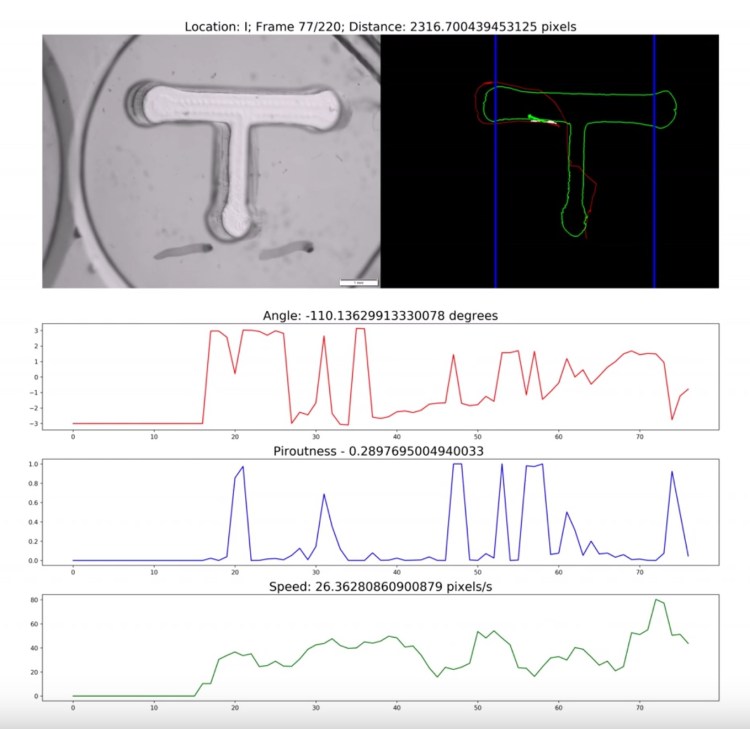
Significant information is hidden in worms’ locomotion features, as they traverse T-mazes. To understand how the presence of reward (food) on one end of the maze or how learning affects their behavior, we need to go deeper than just he outcome of their decision-making (left/right). Data analytics, computer vision and image processing are used in this effort to analyze video recordings and help us decipher C. elegans behavior in a structured environment, also with regard to the animals’ genetic background, age and physiological status. Related publications: here.
Past Projects
Calcium dynamics in C. elegans sensory neurons

Upon stimulation of sensory neurons, intracellular calcium concentration is increased. This is a result of membrane ion channels opening and intracellular calcium stores releasing calcium ions in the cytoplasm. Numerous molecular mechanisms are involved, governing the dynamics of calcium influx and the final return to initial equilibrium upon withdrawal of the stimulus. We built computational models to capture the intracellular cascades dynamics, considering the biophysics of the system and experimental data generated at my postdoctoral research, using C. elegans nematodes as a model system. Related publications: here.
 Gourgou Lab